Juana Inés de la Cruz

Joining a convent was one way to show religious devotion, and sometimes it also had the added benefit of freeing a woman from traditional roles so she could devote herself to learning, writing, irritating the men in charge, and solving music theory problems! Meet Juana Inés de la Cruz!

Sor Juana Inés de la Cruz [a] OSH (12 November 1648 – 17 April 1695) was a Mexican writer, philosopher, composer, poet of the Baroque period, and Hieronymite nun of New Spain (Mexico). Her outspoken opinions granted her lifelong names such as "The Tenth Muse" and "The Phoenix of Mexico", for she was a flame that rose from the ashes of "religious authoritarianism".[1]

Sor Juana lived during Mexico's colonial period, making her a contributor both to early Spanish literature as well as to the broader literature of the Spanish Golden Age. Beginning her studies at a young age, Sor Juana was fluent in Latin and also wrote in Nahuatl,[2] and became known for her philosophy in her teens. Sor Juana educated herself in her own library, which was mostly inherited from her grandfather.[1] After joining a nunnery in 1667,[3] Sor Juana began writing poetry and prose dealing with such topics as love, feminism, and religion.[4] She turned her nun's quarters into a salon, visited by the city's intellectual elite. Among them was Countess Maria Luisa de Paredes, Vicereine of Mexico.[5] Her criticism of misogyny and the hypocrisy of men led to her condemnation by the Bishop of Puebla,[6] and in 1694 she was forced to sell her collection of books and focus on charity towards the poor.[7] She died the next year, having caught the plague while treating her sister.[8]

After fading from academic discourse for hundreds of years, Octavio Paz re-established Sor Juana's importance in modern times.[9] Scholars now interpret Sor Juana as a protofeminist, and she is the subject of vibrant discourses about themes such as colonialism, education rights, women's religious authority, and writing as examples of feminist advocacy.

Sor Juana Inés de la Cruz (12 November 1648 - 17 April 1695) was a Mexican writer, philosopher, composer, poet of the Baroque period, and Hieronymite nun of New Spain (Mexico). Her outspoken opinions granted her lifelong names such as "The Tenth Muse" and "The Phoenix of Mexico", for she was a flame that rose from the ashes of "religious authoritarianism".

Isabella Leonarda

Beethoven isn’t the only composer having a major anniversary year - Isabella Leonarda is as well! Don’t know who she was? Read more below and then check out this excellent video from Pacific MusicWorks! (It’s only available until the end of September)

Isabella Leonarda (6 September 1620 – 25 February 1704) was an Italian composer from Novara, Italy.[2] At the age of 16, she entered the Collegio di Sant'Orsola, an Ursuline convent, where she stayed for the remainder of her life. Leonarda is most renowned for the numerous compositions that she created during her time at the convent, making her one of the most productive woman composers of her time.

Anna Isabella Leonarda was born on 6 September, 1620, the daughter of Giannantonio Leonardi and his wife, Apollonia. The Leonardi were an old and prominent Novarese family whose members included important church and civic officials and knights palatine. Isabella's father, who held the title of count, was a doctor of laws.[3]

Isabella Leonarda (6 September 1620 - 25 February 1704) was an Italian composer from Novara, Italy. At the age of 16, she entered the Collegio di Sant'Orsola, an Ursuline convent, where she stayed for the remainder of her life.

… read more on Wikipedia…

Yearly Stats!

Early Music Monday had a birthday on August 21st! We're now beginning the fourth year of random Early Music tidbits.

To date we've had 35 music history posts, 4 about early instruments, 48 listening examples, 10 about music theory, 30 about people (composers, performers, patrons, etc.), 23 about performance practice, and 4 about musical philosophy. You can explore all of these in the archive!

Onward for year 4!

Do you know these tunes?

Missed the earlier posts in the Name That Tune series? Catch up here:

Part 1 - Carmans Whistle (and how the series started)
Part 2 - Nottingham Ale (with my friends in Seven Times Salt)
Part 3 - Minuet from Overture in G major, TWV 32:13
Part 4 - Canaris from Suite No. 5 in G minor by Jacques Champion de Chambonnières

There are three tunes that have yet to be identified… can you help?
If you know any of these three remaining tunes, let me know!

Name that (early music) tune, part 4 - Canaris from Suite No. 5 in G minor by Jacques Champion de Chambonnières

And the last installment (for now) of our Name That Tune series! If you need to catch up:
Part 1 - Carmans Whistle (and how the series started)
Part 2 - Nottingham Ale (with my friends in Seven Times Salt)
Part 3 - Minuet from Overture in G major, TWV 32:13

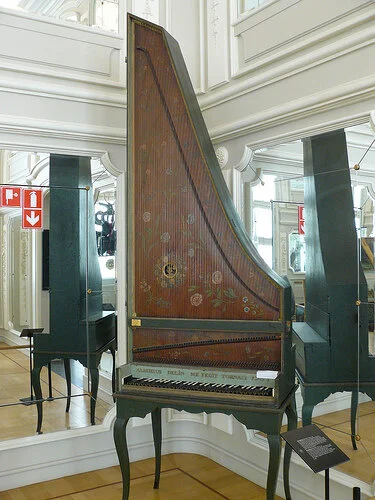
Kudos to Alastair Thompson for his identification of this one! Read more below about harpsichordist and composer Jacques Champion de Champonnières, and then have a listen to the two different ways his tune was used!

Jacques Champion de Chambonnières (Jacques Champion, commonly referred to as Chambonnières) (c. 1601/2 – 1672) was a French harpsichordist, dancer and composer. Born into a musical family, Chambonnières made an illustrious career as court harpsichordist in Paris and was considered by many of his contemporaries to be one of the greatest musicians in Europe. However, late in life Chambonnières gradually fell out of favor at the court and lost his position. He died in poverty, but at an advanced age, and not before publishing a number of his works. Today Chambonnières is considered one of the greatest representatives of the early French harpsichord school.

Chambonnières was born in Paris, most probably in 1601 or 1602. Very little information survives concerning his childhood and early youth. The Champion family included many musicians, most notably Thomas Champion (also known as Mithou; not to be confused with his English namesake), Chambonnières's grandfather, whom Marin Mersenne described as "the greatest contrapuntist of his time." Chambonnières's father, also named Jacques, was also a keyboard player and a composer. Although he was not as highly regarded as Thomas, Mersenne still praised his keyboard skills, and John Bull dedicated a work to him. The title Chambonnières originally belonged to Chambonnières's maternal grandfather: it was the name of a small manor in the commune of Le Plessis-Feu-Aussoux. Chambonnières must have received early music lessons from his father, but apart from that nothing is known about the young harpsichordist's education. What is known, however, is that Chambonnières was for a long time the only child of an aging father—Jacques Champion was around 50 when Chambonnières was born—and received much attention.[1]

Already by 1611 Chambonnières must have been showing considerable musical talents, for in September of that year he received the reversion of his father's court position. Some ten years later, about 1621/22, Chambonnières married his first wife Marie Leclerc. He continued receiving generous financial support from his father until some time in the mid-1620s, when Jacques Champion's wife unexpectedly gave birth to two more children: a daughter (Louise) and another son (Nicolas, or Jehan-Nicolas). Jacques, apparently mindful of both the diminishing family fortune and his elder son's selfish character, sought to distribute the remaining money and resources in a fair manner. In 1631 he completed and signed a document that has since became one of the most important sources of biographical information on the Champion family: a déclaration which detailed family circumstances and, among other things, ordered Chambonnières to pay 3000 livres to his mother, brother and sister as a repayment for the court position and other benefits provided to him by his father.[1]

Jacques Champion de Chambonnières ( Jacques Champion, commonly referred to as Chambonnières) (c. 1601/2 - 1672) was a French harpsichordist, dancer and composer. Born into a musical family, Chambonnières made an illustrious career as court harpsichordist in Paris and was considered by many of his contemporaries to be one of the greatest musicians in Europe.