
John Blanke
Think that Music History is only about white men? Remember that history is written by the victors, and meet John Blanke, a black trumpeter in the royal courts of Henry VII and Henry VIII.
Composers of "The Triumphs of Oriana"
“The Triumphs of Oriana” included works by 23 different English composers, including Thomas Tomkins, Thomas Morley, John Farmer, John Wilbye, and Thomas Weelkes, and was based on “Il trionfo di Dori”, an Italian collection from 1592.
Long live fair Oriana
Notice a pattern? Every madrigal in The Triumphs of Oriana ends with “then sang the shepherds and nymphs of Diana, ‘Long live fair Oriana.’” Those lines were taken from Croce’s “Ove tra l’herbe e I fiori”, which was in turn reworked by Morley as “Hard by a crystal fountain.”
Come Gentle Swains
The Triumphs of Oriana was a collection of English madrigals edited by Thomas Morley and published in 1601 for Elizabeth I. In addition to “Vesta” from last week, it also included “Come gentle swains” by Cavendish.
Word painting in madrigals
Madrigals are famous for their word painting, especially this one by Weelkes. Whether it’s “two by two”, “all alone”, or “ascending” and “descending”, he took advantage of every opportunity with this text!
Ne irascaris
There are so many fascinating topics to explore in Early Music, but the real reason I do what I do is the chance to perform gorgeous pieces like this one.
Christmas Oratorio, part 4
No better way to end 2018 than with Part 4 of Bach’s Christmas Oratorio (which roughly coincides with the New Year)!
In dulci jubilo
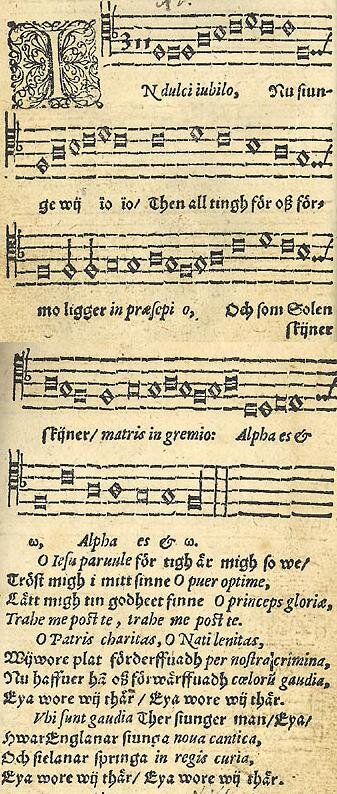
The best Christmas Carols are the medieval ones! Last week’s Guggenheim concerts included Robert Pearsall’s luscious setting of “In dulci jubilo”, possibly my favorite carol of all. Merry Christmas!
Resonet in Laudibus
Michael Praetorius is a familiar name at this time of year, mainly for the carol “Lo how a rose e’re blooming”. His setting of Resonet in Laudibus for 4 soprano parts is on the program I’m singing tonight! Can’t come? Have a listen to Westminster Abbey’s version instead!