Susannah Cibber

One last #MessiahSeason controversy: the alto solos in Handel’s Messiah are frequently sung by countertenors now, but most of them were written for and premiered by a woman - Susannah Cibber.

Susannah Maria Cibber (February 1714 – 30 January 1766),[1] also known as Susannah Maria Arne, was a celebrated English singer and actress. She was the sister of the composer Thomas Arne. Although she began her career as a soprano, her voice lowered in the early part of her career to that of a true contralto. She was universally admired for her ability to move her audiences emotionally both as an actress and vocalist. Possessing a sweet, expressive, and agile singing voice with a wide vocal range, Cibber was an immensely popular singer, even if at times her voice was criticized for a lack of polished technique. Charles Burney wrote of her singing that "by a natural pathos, and perfect conception of the words, she often penetrated the heart, when others, with infinitely greater voice and skill, could only reach the ear." Cibber was particularly admired by Handel, who wrote numerous parts especially for her including the contralto arias in his 1741 oratorio Messiah, the role of Micah in Samson, the role of Lichas in Hercules and the role of David in Saul among others. In the mid-1730s she began appearing in plays in addition to appearing in operas and oratorios. She became the greatest dramatic actress of the eighteenth-century London stage and at the time of her death was the highest-paid actress in England.

Cibber was born in the Covent Garden area of London to Thomas and Anne Arne. Her father and grandfather were upholsterers and office holders in the Worshipful Company of Upholders. As a child she studied singing with her brother Thomas, who would later become one of the most important composers of the era and an important part of Cibber's career as a singer. Her other brother, Richard, also worked as a singer and actor but never achieved the same level of success as his siblings.

Susannah Maria Cibber (February 1714 - 30 January 1766), also known as Susannah Maria Arne, was a celebrated English singer and actress. She was the sister of the composer Thomas Arne. Although she began her career as a soprano, her voice lowered in the early part of her career to that of a true contralto.

Ignatius Sancho

Ignatius Sancho - ever heard of him?
He spent his early life enslaved (and then in service), and was also a writer and composer. Read more about him below and then come hear some of compositions in Handel + Haydn Society’s “Every Voice” concerts this weekend!
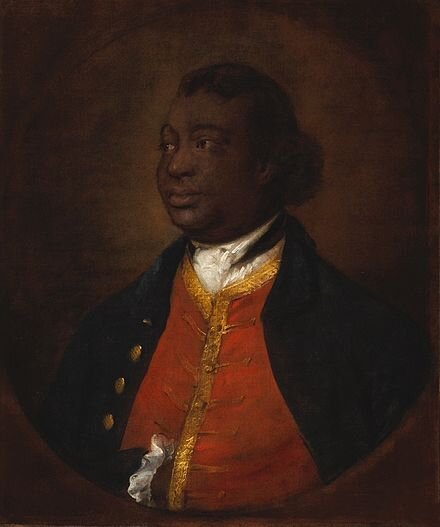
Charles Ignatius Sancho (c. 1729? – 14 December 1780) was a British composer, actor, and writer. He is the only Briton of African heritage known to have been eligible and voted in an 18th century general election through property qualifications. He gained fame in his time as "the extraordinary Negro", and to eighteenth-century British abolitionists he became a symbol of the humanity of Africans and immorality of the slave trade.[4] The Letters of the Late Ignatius Sancho, an African, edited and published two years after his death, is one of the earliest accounts of African slavery written in English by a former slave.

Charles Ignatius Sancho was born on a slave ship crossing the Atlantic Ocean, in what was known as the Middle Passage. His mother died not long after in the Spanish colony of New Granada, corresponding to modern Colombia, Ecuador, Panama, and Venezuela. His father reportedly took his own life rather than live as a slave. Sancho's owner took the young orphan, barely two years old to England and gave him to three unmarried sisters in Greenwich, where he lived from ca. 1731 to 1749. John Montagu, 2nd Duke of Montagu (of the first creation) (1690–1749), impressed by Sancho's intellect, frankness, and his amiability, not only encouraged him to read, but also lent him books from his personal library at Blackheath. Sancho's informal education made his lack of freedom in Greenwich unbearable, and he ran away to the Montagus in 1749. For two years until her death in 1751, Sancho worked as the butler for Mary Montagu (née Churchill), Duchess of Montagu, at Montagu House, where he flourished by immersing himself in music, poetry, reading, and writing.[5][6] At her death in 1751 he received an annuity of £30 and a year's salary, which he quickly squandered.[5]

Charles Ignatius Sancho (c. 1729? - 14 December 1780) was a British composer, actor, and writer. He is the only Briton of African heritage known to have been eligible and voted in an 18th century general election through property qualifications.

Hieronymus Praetorius

If Michael Praetorius was so important, how does Hieronymous Praetorius fit in?

Hieronymus Praetorius (10 August 1560 – 27 January 1629) was a north German composer and organist of the late Renaissance and very early Baroque eras. He was not related to the much more famous Michael Praetorius, though the Praetorius family had many distinguished musicians throughout the 16th and 17th centuries.

He was born in Hamburg, and spent most of his life there. Praetorius studied organ early with his father (Jacob Praetorius, the elder (1520-1586), also a composer), afterwards going to Cologne for further study. In 1580 he became organist in Erfurt, but only remained there two years, returning to Hamburg in 1582. Back in Hamburg he worked with his father as assistant organist at St. Jacobi, becoming principal organist in 1586 when his father died. His son, Jacob, was born that same year, and was also destined to become a composer.

In 1596 he went to Gröningen where he met Michael Praetorius and Hans Leo Hassler; presumably he became acquainted with their music, and through them the music of the contemporary Italian Venetian School, at this time.

Hieronymus Praetorius (10 August 1560 - 27 January 1629) was a north German composer and organist of the late Renaissance and very early Baroque eras. He was not related to the much more famous Michael Praetorius, though the Praetorius family had many distinguished musicians throughout the 16th and 17th centuries.